A few things I wish someone had told me about sex, romance, love, relationships, partnerships, marriage

I’ve made a million mistakes as a parent but I hope on balance I’ve been a worthy example of a human being. That got me thinking about some things I could have benefited from learning a lot sooner than I finally did. Here are a few of them.

1 — If you think someone completes you, you are incomplete and not ready for a serious relationship. No one else can complete you, and you will end up resenting them when that becomes obvious

You don’t have to be a fully baked, perfectly evolved, mature all-knowing person to have a great relationship.  And you can learn a lot from your partner. But you do have to know that no one can fix your life but you.

When considering a partner, perhaps you wonder, “What does he/she/them bring to me?” Spend at least as much time wondering what you bring to them. Will you think, learn, grow, listen, talk and empathize? Do you want a partner with whom to share life’s adventures, joys and sorrows; someone with whom you can build a lifetime of experiences. Or do you want an acolyte to worship at the altar of You?

2 — Sex is fantastic. Enjoy it in whatever form suits you and a willing partner, while knowing that exciting and satisfying sex is not the foundation of a lasting partnership. It may be one of the pillars. It may be a whole wall, but unless you can support more of each other, share more with each other than swollen bits, you’ll tire even of that. PS, it’s better when you can talk about it openly.

Do you share values beyond good lube? One or both of you will change. If you aren’t building to something more than the next mind-blowing climax, you’ll end up sitting across from each other miserably silent over Grand Slams at a Denny’s. (BTW, that is irony, in case Alanis Morissette confused you.)

3 — Speaking of Alanis, music is one of the great joys of life but don’t believe anything you hear in a love song. Most are written by young people who know less about life and love than you do. They may be drawing from their own ill-formed experiences, but their goal is to get you to download their song. For any crouton of real wisdom you may find in a pointed or melancholy lyric, there is a whole loaf of melodramatic and harmful expectations.

Sure, it’s fun to feel sad and weepy over some words that sound just like what you’re going through. But it’s feel-good manipulation. Same with TV shows, movies and theatre.

“I can suck melancholy out of a song as a weasel sucks eggs,” says Jaques, in Shakespeare’s comedy As You Like it. It feels good going in, like a bowl of ice cream, but provides no sustenance.

4 — Speaking of Shakespeare, don’t be a drama addict. Conflict is exciting. It gets your juices flowing. Righteous indignation, just rage, purple jealousy. We all feel entitled to soak in these hot tubs at times. Be aware it can be habit-forming. And like any habit, it comes at a cost. You can’t build something with someone if you are addicted to tearing it down.

5 — Speaking of down, put the toilet seat down when you’re finished peeing, or look before you sit. Not every thoughtless moment is an assault on your humanity. In other words, don’t sweat the small stuff. And don’t keep score. If your partner is consistently thoughtless of your needs, you will know.

6 — Maybe you think you are at that point; wondering if you have a worthwhile, working relationship. Maybe you are at that point. But be aware of the human tendency to romanticize. (See above  – don’t believe anything you hear in a love song.) Maybe that old lover did worship you more. More likely you’re remembering a fantasy. You can almost always trade one situation for another, but if you’re always looking for something better, something perfect, it’s hard to build much of a life. Perfect does not exist because none of us are perfect. Don’t choose a permanent solution to a temporary problem.

We judge others by what they say and do. We judge ourselves by what we intend. That’s how everyone is able to remain the hero in their own story. No one is smarter than everyone. We can all learn from others. Your way of thinking is not the only way of thinking. It is not the way others think, and maybe it’s not even the right way. Failure to understand that is a life in stasis. It is the beginning of death.

Now cheer up, and go live your best life.


READ MORE

Magic Portal to Skinny, New You Is Full of Tongue, Teeth and Stuff

Wouldn’t it be great to lose weight without giving up any of your delicious favourite foods or grunting and sweating through hours of tedious exercise? It turns out, the magic gateway to the slim and sexy you has been right under your nose all along.

That’s right. Now you can Talk Yourself Thin™ using the same pie hole that got you into this mess to begin with.

Using our patent-pending Talk Yourself Thin™ system, the pounds will float away on a breeze, like advice given to your kids.

How is this possible? It’s science. Exhaled breath is mainly made up of water. Heavy, heavy water. In addition to that, it contains more than 250 chemicals, and chemicals weigh a lot. Talk enough and you’ll blow those unwanted pounds right out of your system.

Want to drop a pound? Recite the Gettysburg Address out loud 16 times. Want to lose more? Explain Bitcoin to your dad, or “being woke” to your gran.

“But wait,” you say. You’ve been talking your whole life and you’ve still got enough spare blub to sculpt a handsome lard baby.

Well, sure you do. You’ve been talking all wrong.

Think about it. When do you talk? You go out for a gab over drinks and nachos with friends. You talk with family over meals. You conflab with coworkers over donuts and muffins. And, you’ve been inhaling the calories of everyone you talk with. In short, you have been keeping your body in balance.

The secret to the patent-pending Talk Yourself Thin™ system is long, pointless conversations with yourself. “But I’ll look crazy,” You say. Yes, crazy sexy.

Do you like eating? Do you like talking? Then you’ll love Talk Yourself Thin™.

Talk Yourself Thin™ was developed by Skinny Dreams Ltd. These statements have not been evaluated by the FDA and for all you know may be true. Not available in stores.

READ MORE

Lightfoot doc: As clean, powerful as one of his songs


I walked out into the early evening air, with an achin’ in my heart, after seeing “Gordon Lightfoot: If You Could Read My Mind.” No pockets full of sand; just a rising melancholy over the injustice of age. He had the voice, the look, the musicianship, the poetry and the obsessive work ethic. Why don’t rare talents like that get a pass on aging?

Today, Lightfoot seems to be a spry, genial, intellectually nimble and musically au courant 80-year-old. He’s about as good as you can be at 80, lovingly tending his guitars and still performing, albeit with a wispy voice that’s just an echo of what we remember. Gord, we love you, Gord we miss you.

The tight, 88-minute documentary is playing through mid-June at the Hot Docs Ted Rogers Cinema and elsewhere across Canada. If my American family and friends are lucky, it will soon get some dates in the U.S.

The age-thing is, of course, just a selfish tantrum. Everyone ages, and the years take their toll on us all. Maybe we feel it more achingly when it was one so beautiful.

Writer/producer/directors Joan Tosoni and Martha Kehoe have packed so much into their film. Rare archival clips interspersed with interviews of Gord past and present, and an A-list of musical peers.

They barely have time to sample a few of the hundreds of artists who have covered Lightfoot’s songs. (The audience laughs hard when sparkly-jumpsuit Elvis, the complete antithesis of low-key country boy Gordon, is shown performing If You Could Read My Mind.

Another thing that stands out is the intensity of his work ethic. He was/is a perfectionist. He knew what he wanted from a young age and put himself in a position to achieve it, certainly because of his talent but no less because of the effort he put into making it seem effortless, organic. Every chord progression, every melody, every lyric had to be just right. He was demanding, as much on himself as anyone; as purposeful and active as a colony of ants, perpetually rearranging all the little pieces in pursuit of something bigger.

As it turns out, thoughtful, smart, insightful, poetic music rarely happens in a flash of inspiration. Except maybe in the case of The Wreck of the Edmund Fitzgerald. All of Lightfoot’s preparation, talent and expertise came together over a few days to create that heart-wrenching ballad from the news headlines. Chord progressions, to melody, to lyrics. The details of that anecdote alone are worth the price of admission.Then there’s the Bob Dylan, Joni Mitchell, Johnnie Cash and countless other stories.

The Wreck of the Edmund Fitzgerald was twice as long as the prescribed three-minute pop tunes of the day, but it was too good to be ignored and is still haunting today.

“Does anyone know where the love of God goes when the waves turn the minutes to hours … ”

Like Joni Mitchell, Lightfoot has filled notebooks with lyrics that are magic poetry. Most mortals could die content if they had written any one of those lines. To have been able to marry them with exactly the right music is beyond understanding. Even Lightfoot doesn’t seem to understand how he did it.

I leave the theatre both revering and mourning Gordon Lightfoot – missing the man who is still very much here, and wanting more. The filmmakers should feel proud. The audience doesn’t want their film to end, probably because we don’t want Gordon Lightfoot to end.

READ MORE

Of Rainbow Railroads, Dragons, and Toronto the Good

“There’s nothing more powerful than a good story,” says Tyrion Lannister, saving his skin in the series finale of Game of Thrones with a speech about the power of stories to unite people. A bit self-serving, certainly, not just because it saved his life but more so because it was delivered by an actor, on behalf of writers and film producers, all of whom make their fortunes by telling stories. It was as if the brilliant actor Peter Dinklage looked into the camera and announced: “And now a message from George R.R. Martin and our friends at HBO.”

Still, none of that makes it any less true, and that’s something we need to remember more than ever in today’s toxic political environment. You can’t kill a story, and our stories define us, so let’s be thoughtful about the stories we are creating.

One had only to watch another piece of Sunday evening television for proof. 60 Minutes featured a segment on Toronto-based Rainbow Railroad, the organization that helps LGBTQ people in violently oppressive countries. These are people in mortal peril because of state-sanctioned, or state-perpetrated hateful violence against their own citizens.

The Rainbow Railroad helps them escape and start new lives in safe places. Seeing a gay man who feared for his life everyday in his home country walk down the street in Toronto’s Gay Village in awe that gay couples hold hands in public an no one notices or cares is like seeing one of those videos of small kids who get glasses or hearing aids and see their mom or hear her voice for the first time. It’s a joy to behold.

And so you have the story of Toronto the Good, a nickname that is sometimes used to poke fun at the earnestness and sincerity of today’s Toronto, and to ridicule its puritanical past. That’s a story that unites people, a story people will tell and retell, and ultimately a story that helps us define who we are.

Now, a final juxtaposition: the sour old man I met earlier Sunday at the dog-friendly beach in eastern Toronto. “I’ve lived in Canada 50 years but I won’t call myself a Canadian because of all these non-Europeans they’re letting in.”

Thank you. Please don’t call yourself Canadian, or Torontonian. Lazy, ignorant hatred has no home in Toronto the Good.

READ MORE

Golf and Marriage: Don’t let your new husband use my clubs

In golf, as in marriage, a man’s reach should exceed his grasp.


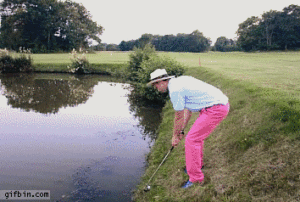
About 30 years ago — the same year I took up marriage — I started playing golf. Today I shot a 122. For those unfamiliar with golf scoring but who know how to keep score in marriage, let me put it this way. Today I left every toilet seat up, forgot our anniversary and her birthday, dropped dirty underwear on the kitchen floor, left the cap off the toothpaste, forgot to pick up the kids, insulted my mother-in-law, drank milk from the carton. And on the par five ninth hole I slept with the nanny. I did everything wrong that can be done wrong.

My favourite golf joke:
Why do they call it “golf?”
I don’t know. Why do they call it “golf?”
Because “fuck” was already taken.

If my marital performance was still as bad as my golf game, I would have been smothered in my sleep decades ago. Unfortunately, mercy killing in golf is discouraged as ungentlemanly.

Golf and marriage follow a similar trajectory. It seems like a good idea at the time. You jump in. It’s much harder than you expected. But with practice and patience you get better. You deal with things as they come up. Impossible pin placements. Water and sand hazards. You learn from mistakes. You correct behaviours that lead to painful outcomes. Or you avoid them. You know you’re never going to hit that three-iron or make that flop shot, so you play it safe to avoid a snow man or a cold shoulder. Eventually your missteps become fewer.

A relevant side note:
A former colleague of mine (@bethteitell) recently wrote a brilliant piece for the Boston Globe about one of the issues couples start discussing later in life – what the surviving person needs to know when the other partner dies first. It can be read here.

The golfing corollary is to discuss what happens to your clubs when you die, which reminds me of another golf joke.

A husband and wife are lying awake in bed late at night, talking about the important things spouses talk about in the quiet darkness at the end of the day, like whether you put out the garbage, turned on the dishwasher or killed the spider in the laundry room, and removed its carcass.

Husband: If I die first, do you think you’ll remarry?
Wife: Oh, I don’t know. I don’t like to think about those things.
Husband: (After a contemplative pause) I think you should remarry. I’d hate to think of you living out your days alone.
Wife: OK, if you say so. Now go to sleep.
Husband: (Another contemplative pause) Do you think you’d live in this house?
Wife: What?
Husband: You and your new husband. Would you live in this house?
Wife: (a bit impatient) I don’t know. Sure. We’d live in this house.
Husband: (Contemplative pause) Would you sleep in this bed?
Wife: (chuckles and decides to play along) Yes. I like this bed. It’s comfortable. I’d keep this bed.
Husband: (pause) I guess that makes sense. OK, good night.
Wife: Good night, you moron.
Husband: (Pause) Just one other thing. Live in the house, sleep in this bed, but don’t let the new guy use my golf clubs. I really don’t want him to use my golf clubs.
Wife: (No pause.) Oh, don’t worry about that. He’s left-handed.

I like to think I have gotten better at marriage; become a better husband. But someone else has to make that call.
I know I have not become a better golfer. There is data. Scores don’t lie. Golf’s goal is to achieve the lowest score you can.

This fact tees up another interesting comparison between golf and marriage. Both are more enjoyable when you don’t keep score. So I try to learn from my mistakes, stay within myself, not swing too hard, savour the good shoots and let go of the bad ones. And all the while, enjoy the walk with a great companion.

One more golf joke:
Two golfers are ready to play on the 11th tee as a funeral procession motors passes by. The first player stops, removes his cap, and bows his head respectfully as the hearse passes.
“That was a really nice thing to do,” the second golfer says. “It’s good to see there is still some respect in the world.”
“Well, it’s only right,” the first golfer replies. “I was married to her for 35 years.


READ MORE

Trump’s “no right” complaint proves he doesn’t know the U.S. Constitution

Donald Trump proved Khizr Kahn’s point about the candidate’s lack of familiarity — and respect — for the United States Constitution. Mr. Trump said Mr. Khan has “no right” to say publicly that Mr. Trump hasn’t read the Constitution.

Two points of fact:
— the First Amendment of the Constitution guarantees Mr. Kahn that right, especially as”fair comment and criticism” on a matter of public importance.
— Mr. Khan, the father of a Muslim-American Army captain killed in Iraq, did not say Mr. Trump has not read the Constitution. He asked the question: “Have you even read the US Constitution?”

It’s a reasonable question, given Mr. Trump’s many statements that suggest a disregard for Constitutional rights.

Mr. Trump’s statement that Mr. Kahn had “no right” suggests that either Mr. Trump has not read the Constitution, does not recall it or understand it, or holds a reckless disregard for it. For this and many other reasons, those who support Mr. Trump and think of themselves as true patriots and defenders of the Constitution, are well served to think about whether they are really backing a candidate who will “preserve, protect and defend the Constitution of the United States.”

But the, the presidential oath also says “to the best of my ability,” and Mr. Trump has been entirely transparent in demonstrating his ability to understand and value the Constitution, so he won’t be violating his oath when he ignores and undermines it.

http://usat.ly/2anDzBq

READ MORE

A Father’s Day Confession — The Seven Daddy Sins

By Geoffrey Rowan

For almost every father I’ve known, nothing brings more happiness than fatherhood. It feeds our souls in the face of inner devils, ambitions, victories, defeats and even the sports channel. On Fathers’ Day, it is we who are thankful – that we get to be fathers. Sure, bring on the ties, cologne and dog-eared books from the discount bin but even if the day passed unrecognized, we would feel we won life’s lottery.

That said, the way we feel may not always be reflected in the way we act. “I myself am made entirely of flaws, stitched together with good intentions,” said the writer Augusten Burroughs. “Me too,” said I.

In the interests of coming clean, I freely confess to these seven deadly sins of my flawed fatherhood efforts – the seven daddy sins.

Sloth – As you always suspected, I was not sound asleep and unable to hear the baby crying. Sorry.
Lust – But I was awake enough for that.
Gluttony – Once you have developed a taste for gnawed, drool-coated teething-biscuit ends, you have lost any claim on dignity. Mac-and-cheese from the kitchen floor, baggies of stale Cheerios and crushed cheese sticks in every pocket, and who put Oreos and Fudgeos in the grocery cart? I did.
Pride – Thank god my kids are better than yours.
Envy – Why aren’t my kids as good as yours?
Anger – I literally had just fallen asleep when you decided to see who could hit the highest note the loudest.
Greed – I want to hang onto this forever. Don’t you dare grow up.

Now that I’ve gotten that off my chest, from one imperfect dad on behalf of compadres everywhere, thanks for every day, and happy Father’s Day.

READ MORE

Men are from Hooters, Women are from Christian Louboutin

By Geoffrey Rowan

Walk with me ladies and let’s explore one of the great mysteries of hetero maleness. You may view it as a tolerable, even comical idiosyncrasy of the Y chromosome, or perhaps a weak insensitivity, a sexist deal-breaker, or just the way it is.

However you deal with it, at some point you have wondered why your boyfriend/husband/employee/employer/father/grandfather or any other hetero man cannot stop himself from ogling the waitress’s bosom when she bends over the table?

Sex in the city shoes

I don’t know. But there is a single word that may help you understand and even related to their helplessness; a word that offers you a visceral, emotional light-bulb insight into their slavering. It is offered here as a public service to increase understanding between the sexes.

That word is shoes.

Like breasts, shoes are functional objects that come in pairs and inspire lust. A pair of one to feed the children and of the other to protect your feet from the elements. You’d think that would be the end of it. What could be more mundane?

Why then must men and boys of every age always look? Science has its theories.
Maybe breast-obsessed men have mommy issues, or have been programmed by media’s constant sexualizing of the breast, or are stuck in an adolescent sex loop. These are all reasonable speculations and there are others. But do any of them satisfy your desire to know why he can’t stop?

Intellectually, you know your contented life partner doesn’t really want to blow up his family in order to get his hands on the freckled cleavage of the bank teller. So why must he look? He is smart enough to silently remind himself “eye contact, eye contact, eye contact” during meetings with his boss. And certainly he knows his semi-salacious, never-subtle-enough glance is not really going to ignite the bartender’s loins or inspire his hair stylist to rip open her bodice and mount him in the chair.

But then, you know that no matter how hard you press your nose against the storefront glass on Fifth Avenue, no matter how profoundly you long and sigh over glossy magazine pages, you’re not going to blow the family budget on that $1,000 pair of Manolos. Why must you look? In your fantasy world, you buy them all.

So, before you bust him for not-so-subtly trying to catch a glance of waitress décolletage, admit it. You had already checked out her shoes. Cute ballet flats. When you’re walking down the street together and he does the head swivel, like radar tracking an incoming brace of inter-ballistics, admit you had already checked her out, and were lingering dreamily on her Prada Studded Shoe Booties in grey.

There are as many attempted rationalizations for women’s shoe-porn addiction as for male titillation, and they are about as reasonable. Some say shoe size rarely fluctuates, so women never have to beat themselves up over not being able to fit into their skinny slingbacks.

Another rationalization in the self-esteem category: heels lengthen the leg and lift the buttocks, highlighting posture and curves in a way that inspires feelings of self-confidence and sexiness.
Maybe, but we’re not buying, ladies. Neither explains the feelings of breathless excitement and urgent desire so many women report having when they look at pictures of shoes, see them on display or fondle them in a store.

Women’s shoes and women’s breasts are sensuous and sexy, to women and men respectively and often collectively. The curves, colours, lines, shapes, supple textures, the ratios and juxtapositions, the totality of the experience and the sublime exquisiteness of each molecule that comprise them. The imagined conversation between fingertips and skin. The intoxicating smell of new shoe/boob. The fantasy. Blahnik, Louboutin, Prada, Chanel. Big, small, pert, pendulous.
Breasts and shoes are secondary sexual characteristics. Each provokes feelings of desire and sexuality, but you don’t actually have sex with them. Well, most people don’t.

“I love shoes, desire and lust after them,” Alyssa Siegel wrote in Psychology Tomorrow Magazine, after attending Shoe Obsession, an exhibition at The Museum of New York’s Fashion Institute of Technology. “I feel my heart race when I look at shoes I am considering buying, feel a jolt of joy when I wear them the first time.”

She desires them all. “Flats, heels, boots, ballets, sandals, clogs, platforms, wedges, strappy, buckled, lace-ups, peep-toes.”

Compare that to Andre Cross, writing in AskMen.com: “Yes, I like big breasts, but I like small breasts as well. I have never encountered a breast that I didn’t like. There are only two things I require from a woman’s breast: nipples and accessibility.

Breasts have a gravitational pull on hetero men only slightly weaker than the sun’s gravitational pull, right before you’re sucked into it and vaporized. Maybe that’s because the 14-year-old who still inhabits the rec room of the hetero male mind believes breasts are the on button for female sexuality. Push here to ignite. Of course that is stupid (right?). But have you ever seen guys under the influence in a strip club? Not the peak of our self-aware, intellectual selves.

Have you ever seen women under the influence in a shoe store? Same-same. Same feigned insouciance, trying to look just as chill and nonchalant as guys in a strip club, but a little too much animation in the voice, a little too giddy.

Still, if shoe store is to woman as strip club is to man, there are some important differences. You can’t get microwaved nachos in a shoe store, and few have football on big-screen TVs to provide a respite from the constant, emotionally exhausting visual stimulation.

But then, in a shoe store, you can touch the object of your desire all you want with no fear that a 350-pound guy named Tiny will grab you by your upper lip and back of your pants and toss you to the sidewalk. And you don’t have to pay $20 a song to sit with a pair of Manolos on your lap.

In the end, there is no convincing explanation for the lust-inducing powers of shoes/breasts. A breast is an erogenous zone located on a woman’s body. A shoe store is an erogenous zone located in a mall.

Nor should we want to live in a world that has demystified the allure of the shoe/breast. All we should care about is that no shoe/breast goes unadored. A flat can be as sexy as a four-inch stiletto. Strappy, buckled, lace-ups, peep-toes. They’re all good. They all bring happiness.

All except for espadrilles. They are a shoe that says: “I don’t like the way you’re looking at me, and don’t even think about touching me.”

READ MORE

Weasel words and the failure of leadership: we get what we accept

By Geoffrey Rowan

TORONTO, March 20, 2012 — Short-sheeting your brother’s bed is a dirty trick.(“Ohh, you brat!”)  Impersonating a government official to rig an election is a felony.

But the sad truth is most of us don’t care. We don’t expect any better from our leaders. We don’t believe what they say, and who can blame us. In the political arena, at least, we have been conditioned to ignore all the faux wounded hyperbole and ersatz indignation of our leaders. Every day someone in government does something so egregious it can only be fixed by his or her resignation, or the prime minister’s resignation or someone’s ceremonial disembowelment. Who’s to know when something serious actually happens?

Many if not most business leaders are just as disingenuous, obtuse, evasive and self-serving. Leadership in the worlds of religion, not-for-profits and at the local community level is no more inspiring. If perception is reality then we are one sorry family of man because around the world we perceive our leaders as a dismal lot.

You know this because you are aware of the U.S. race for the Republican presidential nomination, or our own robo-call scandal, a dysfunctional city council and mayor’s office or countless other examples that range from bumbling buffoonery to malicious malfeasance. I know it because my colleagues in research at Ketchum surveyed people in 13 countries to find out what they think about leaders. The results were dismal. (Here’s the link to the results media release – http://bit.ly/GCotzV)

There is a huge gap — a 28 percentage point difference — between what we expect from our leaders and what we think they deliver.

Business leaders were the best of a weak lot globally, with a little more than a third of respondents giving them an excellent rating of eight or above on a scale of 0-10. (In Canada, not-for-profit leaders were best.) Even more surprising, among businesses, leaders in banking and financial services rated near the top of the pack. (Leaders of tech companies were rated highest by 44 per cent of respondents for effective leadership, compared to consumer packaged goods firms at the opposite end of the spectrum, cited by just 20 per cent for effective leadership.)

As jaded as we are in our view of leaders, we’re still hopeful. We want good leaders and believe that we need them to guide us through these difficult times. And we don’t seek the impossible in leadership. Around the world, across many countries and languages, people were pretty consistent about their expectations in response to this survey.

1. Close the Say-Do Gap — People aren’t as stupid as our leaders seem to think. If you say you love people and then you bomb them, or take away their jobs, or their health care, or abuse their trust, they will grow cynical. We want more from our leaders than catchy slogans and lyrical sound bites. We want people who lead by example, who have the courage and commitment to act, and who keep a level head in a crisis.
2. Strong, Silent Types Need Not Apply — As important as it is to act decisively and with integrity, leaders also must keep people informed. In the absence of clearcommunication – whenever there is ambiguity – we will assume the worst. So, no to slogans and sound bites but yes to clear, consistent communication, with a little humility. Be willing to admit mistakes. Be aware that different situations require different leadership styles, and different leadership styles require different communication styles, but they all require good communication.
3. Don’t sugar-coat it — The survey was decisive on this. Speak the truth with purpose and without ambiguity. We can handle a challenge if we understand it and if we know what our leaders are doing to address it.
4. The way to be seen to be trustworthy is to be trustworthy — (See No. 1, Close the Say-Do Gap.) For organizations to be seen to be leaders, nothing rated higher in the survey than trustworthiness, including quality of products, services or management, financial strength, or innovation.
5. Let Them Look You In The Eyes — Face-to-face communication is by far thecommunication channel that creates the greatest sense of leadership credibility. The lack of credibility given to some digital communication channels was surprising given their fast proliferation, but we believe Twitter feeds and social media were useless for leadership is because most of the content doesn’t meet the other criteria for effective leadership. It’s usually bland marketing speak and sloganeering, and it’s rarely actually written by the leader. Does anyone believe Stephen Harper writes his own Tweets?

The bad news is that we have grown so cynical that we expect our leaders are going to be even worse in 2012 than they were in 2011. There is such a powerful hunger in so many to be anointed “a leader” and then to hang onto that perceived power that they have forgotten the fundamental tenet of leadership – that they work for the people they are leading.

And so cynicism grows, and alientation, and disengagement, until we end up with leaders no one listens to, or until a new kind of leader emerges — one who leads instead of manages. That’s where leadership opportunity exists now.

READ MORE

Business, Political, Religious Leadership a Big Disappointment

Leadership crisis expected to worsen, Ketchum global survey reveals

  • Canadians rate not-for-profit leaders best of a weak lot of leaders
  • Globally, business leaders rated first; bankers surprise
  • Politicians rated worst on leadership; vast gap between expectation, reality
  • Traditional media far outperforms social media for leadership credibility

TORONTO, March 20, 2012 – Leaders in business, politics, religion, local communities and the not-for-profit sector fall far short of expectations around the world, according to a 12-country survey by global communications firm Ketchum, and we expect it to get worse this year.

The survey found a 28-percentage-point gap between respondents’ expectations of leaders and their view of how well leaders are meeting those expectations.

In Canada*, survey respondents were at least as harsh in their judgment of leaders as elsewhere, but rather than rating business leaders as the best of a weak lot, Canadians gave that recognition to leaders of not-for-profit organizations.

Canadians gave not-for-profit leaders a mean score of 6, on a sale of 0-10, for effective leadership. Canada’s business leaders followed with a mean score of 5.6 out of 10. Canadians rated political leaders tied for last place, with celebrities, with a 4.2 mean score.

Besides showing the depth of the world’s lack of faith in our leader, the global survey also provides a roadmap for leadership effectiveness. Being perceived as an effective leader requires a combination of decisive action and honest, transparent communication, which is best achieved through a leader’s personal presence and involvement.

“Our study reveals for the first time the full extent of the world’s disappointment with its leaders across every category of human endeavour,” said Geoffrey Rowan, managing director of Ketchum’s Canadian operations and a partner in the global firm. “But the research is also full of practical insights – a clear blueprint for more effective leadership. One point of clarity was how inextricably linked effective leadership is to effective communication.”

A surprise finding outside of Canada, given the lingering global financial crisis, business leaders were seen as the most effective over the past year – beating politicians, not-for-profit bosses and religious leaders. But in Canada, not only did not-for-profit leaders get the highest mean score. They also got the highest number of “excellent” ratings (8 or above on a scale of 0-10) at 23 per cent. Globally, it was the business leaders who got the most excellent ratings, at 36 per cent.

“The key to leadership, particularly in the ‘social profit’ sector, is knowing what to do with it,” said Rahul Bhardwaj, president and CEO of Toronto Community Foundation, one of Canada’s most far-reaching not-for-profits. “When working to build stronger communities, cities, and, by extension, a stronger country, it’s important to remain focused, transparent and committed to open and authentic communication. You must be guided by and communicate strong values – be constructive not destructive. “Above all, don’t confuse managing with leading.”

Within the business community globally, knowledge-based industries were perceived as having the most effective bosses. Ranked highest on leadership effectiveness was technology, with a 44 per cent approval rating, followed by media (39 per cent) and telecommunications (36 per cent). Banking chiefs came in fourth overall in the poll worldwide with 32 per cent. The energy sector and financial services leaders were ranked fifth (31 per cent) and sixth (30 per cent) respectively. Consumer business leaders lagged far behind on leadership, with consumer packaged goods leaders being rated effective by only 20 per cent.

Perhaps most significant for the business community, the research makes a direct link between positive perceptions of leadership and business-critical decisions such as a willingness to buy stock, goods and services or recommend working at a company. This explains crisis response being seen as the most important area for business leaders to communicate personally (53 per cent), followed by financial results (48 per cent) and the state of the business (40 per cent).

Personal Leadership and Powerful CommunicationA Direct Link

Clear, transparent communication topped the table of key leadership behaviours globally. For 84 per cent, effective communication is extremely important to strong leadership, while 48 per cent rated it as the number one factor. In Canada, not-for-profit and business leaders tied for top spot in effective communication, at a fairly dismal mean rating of 5.7 out of 10. Political and religious leaders tied with the lowest mean rating of 4.6 on effective communication.

Action also matters in rating leadership. Being able to make the tough decisions, leading by example and staying calm in a crisis rated immediately behind effective communication. The study revealed that the number one action leaders should take to restore confidence in 2012 is to be open and honest about the nature and scale of the challenge ahead (57 per cent US; 52 per cent Europe vs. 43 per cent China). By contrast, only 17 per cent indicated a preference for leaders to spare them the full picture to avoid panic.

Trustworthiness was seen as the number one source of leadership credibility for corporations, placed above quality of management and financial strength. In order to win that trust, the report found that the personal “presence” and involvement of a leader in communicating was vital. As a result, communication via face-to-face and traditional media left social media trailing. Face-to-face contact provided the greatest source of leadership credibility (50 per cent), followed by televised speeches (43 per cent), broadcast media (41 per cent) and print media (38 per cent). Digital platforms and social media were well off pace, with blogs at 20 per cent, Facebook at 16 per cent, advertising at 13 per cent and Twitter at just 8 per cent.

“We were a little surprised that mainstream media was still far ahead of digital and social media in conveying leadership credibility,” said Mr. Rowan. “The message we take is that most organizations aren’t using social media as a leadership channel. It’s mostly used to push marketing messages, and even when a leader’s name is involved, most people don’t believe it’s the leader who is actually communicating. This doesn’t mean we should write off social media as a channel for building credible leadership but rather that we have to make the authentic ‘presence’ of the leader shine through.”

Visit http://bit.ly/GAcy8S for additional survey information and materials. # # # About the Leadership Communication Monitor Ketchum Global Research & Analytics and Ipsos Observer, a worldwide strategic business line within Ipsos, conducted an online survey of 3,759 respondents in 12 markets from Dec. 14, 2011 to Jan. 10, 2012. These were theUnited States, United Kingdom, France, Germany, Spain, Poland, China, Singapore, India, the United Arab Emirates, South Africa and Brazil. The global margin of error is +/-1.6%. About Ketchum Ketchum is a leading global communications firm with operations in more than 70 countries across six continents. Named 2012 Agency of the Year (PRWeek) and the winner of an unprecedented three consecutive PRWeek Campaign of the Year Awards, Ketchum partners with clients to deliver strategic programming, game-changing creative and measurable results that build brands and reputations. For more information on Ketchum, a unit of Omnicom Group Inc. (NYSE:OMC), visit http://www.ketchum.com. About the Canadian Survey From March 15th, to September 16th, 2012, an online survey was conducted among a sample of 1,003 Canadian adults 18 years plus, who are Angus Reid Forum panel members. The Angus Reid Forum is owned and operated by Vision Critical. Individuals were sampled according to Census data to be representative of the Canadian national adult population. The full dataset has been statistically weighted according to the most current gender, age, region, education (and in Quebec, language) Census data to ensure a sample representative of the entire adult population of Canada. The margin of error is ±3.1%, 19 times out of 20. Discrepancies in or between totals are due to rounding. About Ipsos Ipsos is an independent market research company controlled and managed by research professionals. Founded in France in 1975, Ipsos has grown into a worldwide research group with a strong presence in all key markets. In October 2011 Ipsos completed the acquisition of Synovate. The combination forms the world’s third largest market research company. With offices in 84 countries, Ipsos delivers insightful expertise across six research specializations: advertising, customer loyalty, marketing, media, public affairs research, and survey management. Ipsos researchers assess market potential and interpret market trends. They develop and build brands. They help clients build long-term relationships with their customers. They test advertising and study audience responses to various media and they measure public opinion around the globe. Ipsos has been listed on the Paris Stock Exchange since 1999 and generated global revenues of €1,363 billion (1.897 billion USD) in 2011. Visit http://www.ipsos.com to learn more about Ipsos’ offerings and capabilities.

Contact: Sydney Dare —  416-355-7427 — sydney.dare@ketchum.com

* The Canadian survey – the 13th country – was conducted for Ketchum by Vision Critical. It was conducted later than the surveys in other countries and asked fewer questions, which may have affected results

READ MORE